Three lines carry almost all the information: HPLC purity, the mass spectrometry result, and the batch number. Purity tells you what fraction of the peptide-related material is the sequence you ordered. It does not tell you how much peptide is in the vial. Everything else on the page is either a restatement of those or a field nobody filled in.
The most expensive misreading is treating purity as content. A vial can be 99% pure and still be well under its labelled milligrams, and the certificate will say both things without ever putting them next to each other.
The chart: what each line means
- HPLC purity (e.g. 99.2%): of the peptide-related material detected, this fraction is the target sequence. Says nothing about vial mass. Purity is one of several separate quality attributes a peptide is characterised against.[1]
- Mass spectrometry / MS result: confirms the molecule is the one intended. Mass spectrometry is the method used to establish product identity.[2] A matching mass is a yes-or-no answer, not a grade.
- Molecular formula and molecular weight: the theoretical values. Compare against the observed MS figure. They should agree to within about one mass unit.
- Appearance: “white lyophilised powder”. Useful only when it says something else.
- Counterion / TFA content: the acid retained from purification, reported as a percentage of mass. Trifluoroacetate is a routine counterion in synthetic peptides, measured and exchanged as its own quality attribute.[3]
- Water content: residual moisture, also part of vial mass rather than peptide.
- Batch or lot number: the only field that ties the document to your vial. If it does not match the vial label, the certificate describes a different batch.
- Date of analysis: when the batch was tested, not when your vial was filled.
- Endotoxin, sterility, heavy metals: separate tests. Absent unless explicitly reported.
The gap between purity and content
Purity is a ratio within the peptide-related material. The rest of the vial mass is counterion, water and salt, and none of that shows up in a purity figure. Two vials can both read 99% pure and differ meaningfully in how much peptide each contains, which is why the counterion and water lines matter more than they look.
Match the batch number to the vial
Do this before reading anything else. A certificate for a different lot is a document about someone else’s peptide.
Read the purity figure and then ignore it for a moment
99% and 98% are not meaningfully different for most purposes. The interesting question is what the remaining percent is, and the purity number alone never answers it.
Check the observed mass against the theoretical mass
They should agree closely. A mismatch is the one unambiguous red flag on the whole document, because it means the compound is not what the label says.
Find the counterion and water lines
If they are absent, the certificate is not telling you what fraction of the vial is peptide. That is a gap, not a pass.
Look for what is missing
Endotoxin, sterility and heavy metals each require their own assay. Their absence from the page means they were not tested, not that they passed.
Check who issued it
A certificate from the manufacturer is a self-report. A certificate from a named independent laboratory is a different kind of document, and the difference is the whole value of the field.
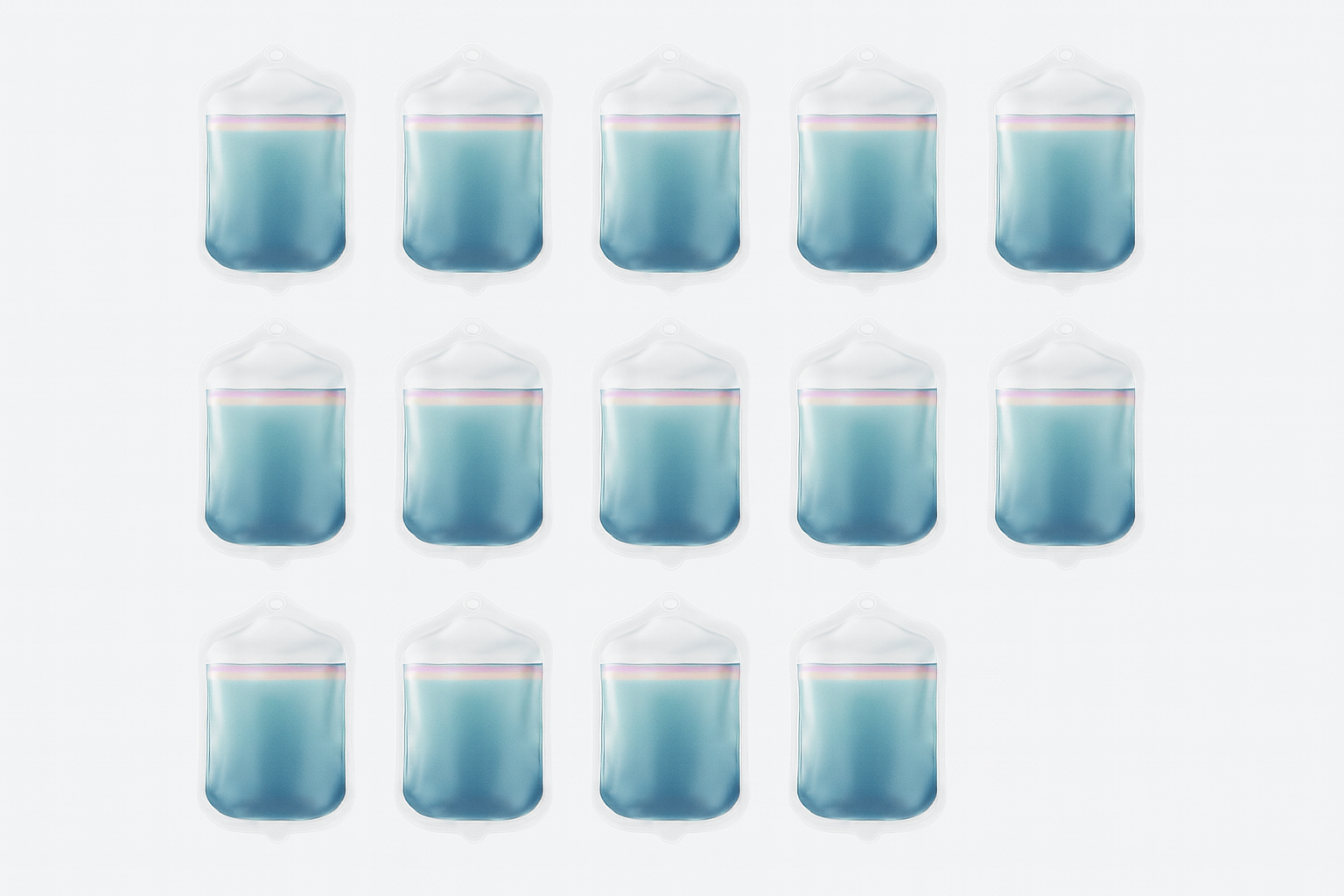
The purity figure describes the tall part. The thin band at the top is the part nobody itemises.
What the missing percent contains
The gap between 99% and 100% is not random noise. It is a specific and characterisable set of species.
- Process-related impurities. These come from the synthesis itself and are distinct enough to be synthesised and characterised individually, which is exactly what one group did for a peptide drug’s two known impurities.[4]
- Degradation products. Storage generates its own impurities. Modes of degradation and the resulting impurities have been characterised in a peptide drug across stability studies.[5]
- The hard ones. Species closely related to the target are the difficult case for chromatographic separation, because small structural differences resolve poorly.[6] The impurities most likely to survive purification are the ones most similar to the peptide you wanted.
The consequence: a high purity figure is most reassuring about the impurities that are easiest to remove, and least informative about the ones that are chemically closest to the target.
What a certificate does not cover
Three separate things, each needing its own test:
- Endotoxin. Bacterial endotoxin testing is its own required assay for parenteral products.[7] A purity figure implies nothing about it.
- Sterility. A distinct test with its own method, separate from any chemical analysis.[8]
- Whether the vial contains the labelled mass. Purity is a ratio. Mass is a weight. The certificate reports the first and the label asserts the second, and nothing on the page connects them.
The honest limits
- A certificate describes a batch. Unless the lot number matches the vial in your hand, it describes something else.
- A self-issued certificate is a self-report. Nothing on it is independently verified unless a third-party laboratory issued it, and most are not.
- A missing line is not a passing grade. Every absent field is an untested attribute.
Read the batch number first, the observed mass second, and treat the purity percentage as the least surprising number on the page. The fields people skip, counterion, water and who signed it, are where the actual information is.
This article is for research and informational purposes only and is not intended to diagnose, treat, cure, or prevent any disease. The peptides discussed here are sold for research use only and are not for human consumption. Nothing in this article constitutes medical advice. Consult a qualified clinician before making changes to a health, training, or supplementation protocol.
References
- Reference Standards to Support Quality of Synthetic Peptide Therapeutics.. Pharmaceutical research, 2023.
- Development and validation of a mass spectrometric method to determine the identity of rituximab based on its microheterogeneity profile.. Journal of chromatography. B, Analytical technologies in the biomedical and life sciences, 2020.
- Towards a Consensus for the Analysis and Exchange of TFA as a Counterion in Synthetic Peptides and Its Influence on Membrane Permeation.. Pharmaceuticals (Basel, Switzerland), 2025.
- Synthesis and characterization of two potential impurities (des-ethyl-Ganirelix) generated in the Ganirelix manufacturing process.. Journal of peptide science : an official publication of the European Peptide Society, 2023.
- Modes of Degradation and Impurity Characterization in rhPTH (1-34) during Stability Studies.. PDA journal of pharmaceutical science and technology, 2011.
- Chromatographic resolution of closely related species in pharmaceutical chemistry: dehalogenation impurities and mixtures of halogen isomers.. Analytical chemistry, 2014.
- Barriers to the Use of Recombinant Bacterial Endotoxins Test Methods in Parenteral Drug, Vaccine and Device Safety Testing.. Alternatives to laboratory animals : ATLA, 2023.
- Sterility testing of antimicrobial-containing injectable solutions prepared in the pharmacy.. American journal of hospital pharmacy, 1991.