Add 2 mL of bacteriostatic water to a 10 mg vial. That gives you 5 mg/mL, so a 500 mcg dose is 10 units on a standard U-100 insulin syringe. Aim the water down the inner wall of the vial, swirl instead of shaking, and refrigerate once it is dissolved.
That is the whole procedure. The chart below covers every other vial size, and the chemistry at the end explains why the two steps people rush are the two that matter.
The three most common vials
| Vial + water | Concentration | 500 mcg dose |
|---|---|---|
| 5 mg + 2 mL | 2.5 | mg/mL, so 20 units |
| 10 mg + 2 mL | 5.0 | mg/mL, so 10 units |
| 20 mg + 2 mL | 10.0 | mg/mL, so 5 units |
Doses are units on a U-100 insulin syringe.
What you need
- The lyophilised peptide vial
- Bacteriostatic water, which is sterile water with benzyl alcohol as a preservative
- Alcohol swabs
- A 3 mL syringe for transferring the water
- A U-100 insulin syringe for drawing doses
The chart: every vial size
Concentration and syringe units by vial size
| Vial | Water added | Concentration | 250 mcg dose | 500 mcg dose | 1 mg dose |
|---|---|---|---|---|---|
| 5 mg | 2 mL | 2.5 mg/mL | 10 units | 20 units | 40 units |
| 10 mg | 2 mL | 5 mg/mL | 5 units | 10 units | 20 units |
| 15 mg | 2 mL | 7.5 mg/mL | 3.3 units | 6.7 units | 13 units |
| 20 mg | 2 mL | 10 mg/mL | 2.5 units | 5 units | 10 units |
| 30 mg | 3 mL | 10 mg/mL | 2.5 units | 5 units | 10 units |
| 40 mg | 4 mL | 10 mg/mL | 2.5 units | 5 units | 10 units |
Units are on a standard U-100 insulin syringe, where 100 units is 1 mL.
The 30 mg and 40 mg vials take more water on purpose. Putting 2 mL into 30 mg makes every dose too small to measure accurately on the syringe.
The two formulas behind that chart
Concentration (mg/mL) = milligrams in the vial ÷ millilitres of water added.
Units on a U-100 syringe = (dose in mg ÷ concentration in mg/mL) × 100.
A U-100 syringe puts 100 units across 1 mL, so one unit is 0.01 mL. This is where the order-of-magnitude errors happen: the syringe is marked in units, not millilitres. Our dosage calculator takes the vial size, the water volume and the target dose and returns the syringe marking, so the conversion is not something you do by hand at the kitchen table.
Pick the water volume so your dose lands on a round number
More water is not more dilute in any way that matters, it just changes which mark you draw to. Choose the volume that puts your usual dose between 5 and 30 units on the syringe. Below 5 units the measurement error is a large share of the dose; above 30 you are refilling the vial constantly.
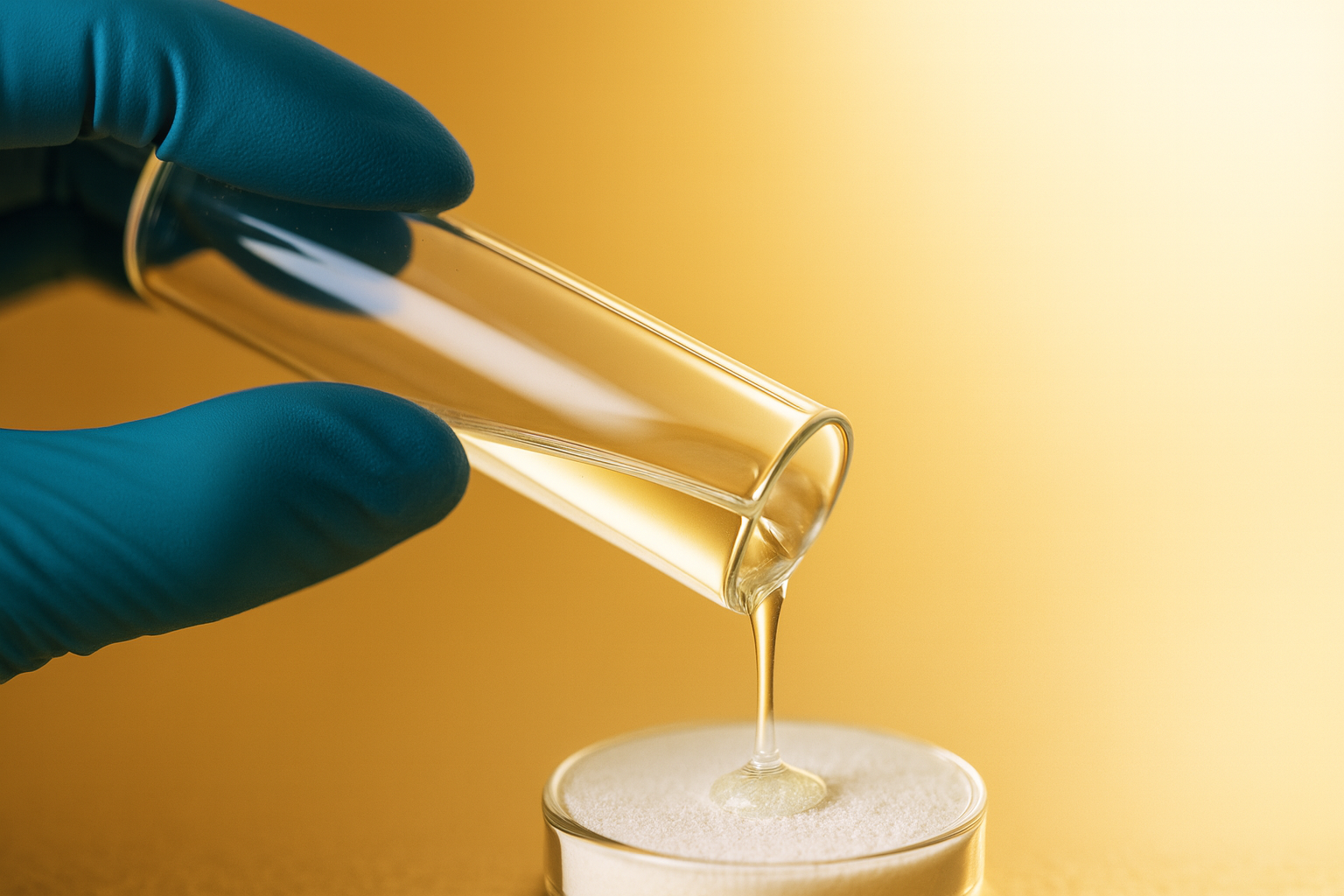
The stream goes down the glass, not into the cake. This is the step with the clearest evidence behind it.
Swab both stoppers
Alcohol swab on the peptide vial and on the bacteriostatic water vial, every time, before any needle goes in. Handling is where contamination comes from, not the air in the room.
Draw the bacteriostatic water
Use the 3 mL syringe. Draw the exact volume you chose from the chart. Air in the syringe is not a problem at this stage; volume accuracy is.
Inject the water down the wall of the vial
Angle the needle so the stream runs down the inside glass wall rather than jetting into the powder cake. This is the step with the clearest experimental support behind it and the one most often skipped, and the reason is in the chemistry section below.
Let it dissolve, and swirl if you must
Set the vial down for a few minutes. If some cake remains, roll the vial gently between your fingers. Do not shake it. Shaking is the standard laboratory method for deliberately inducing aggregation, which is the opposite of what you want.
Check the solution before you use it
It should be clear and free of particles. Cloudiness or visible floaters mean discard, whatever the date says.
Label and refrigerate
Write the reconstitution date on the vial and put it in the fridge, away from the door where the temperature swings. Do not freeze a vial you intend to use again.
How long it lasts once mixed
There is no general answer, because stability is measured compound by compound and those studies do not exist for most research peptides. The nearest useful anchor: refrigerated multi-dose insulin vials remained sterile through six months of use in a published study.[1]
6 months how long refrigerated multi-dose insulin vials stayed sterile in use PMID 37559404
That number is about sterility, not potency. It applies to a preserved commercial formulation handled in a clinical setting. It is a ceiling on what good technique can achieve, not a shelf life for your vial.
What goes wrong, and what it costs you
- Jetting the water into the cake. Maximises the interfacial stress that drives aggregation. You lose active peptide with no visible sign.
- Shaking to speed dissolution. Same failure, faster.
- Reading units as millilitres. A tenfold dosing error before the peptide is involved at all.
- Freezing a reconstituted vial. Freezing induces aggregation through a pH shift as the solution concentrates during ice formation.
- Using sterile water for a multi-draw vial. No preservative, so it is a single-use product once opened.
- Not writing the date on the vial. The date is the only information you have about how old the solution is.
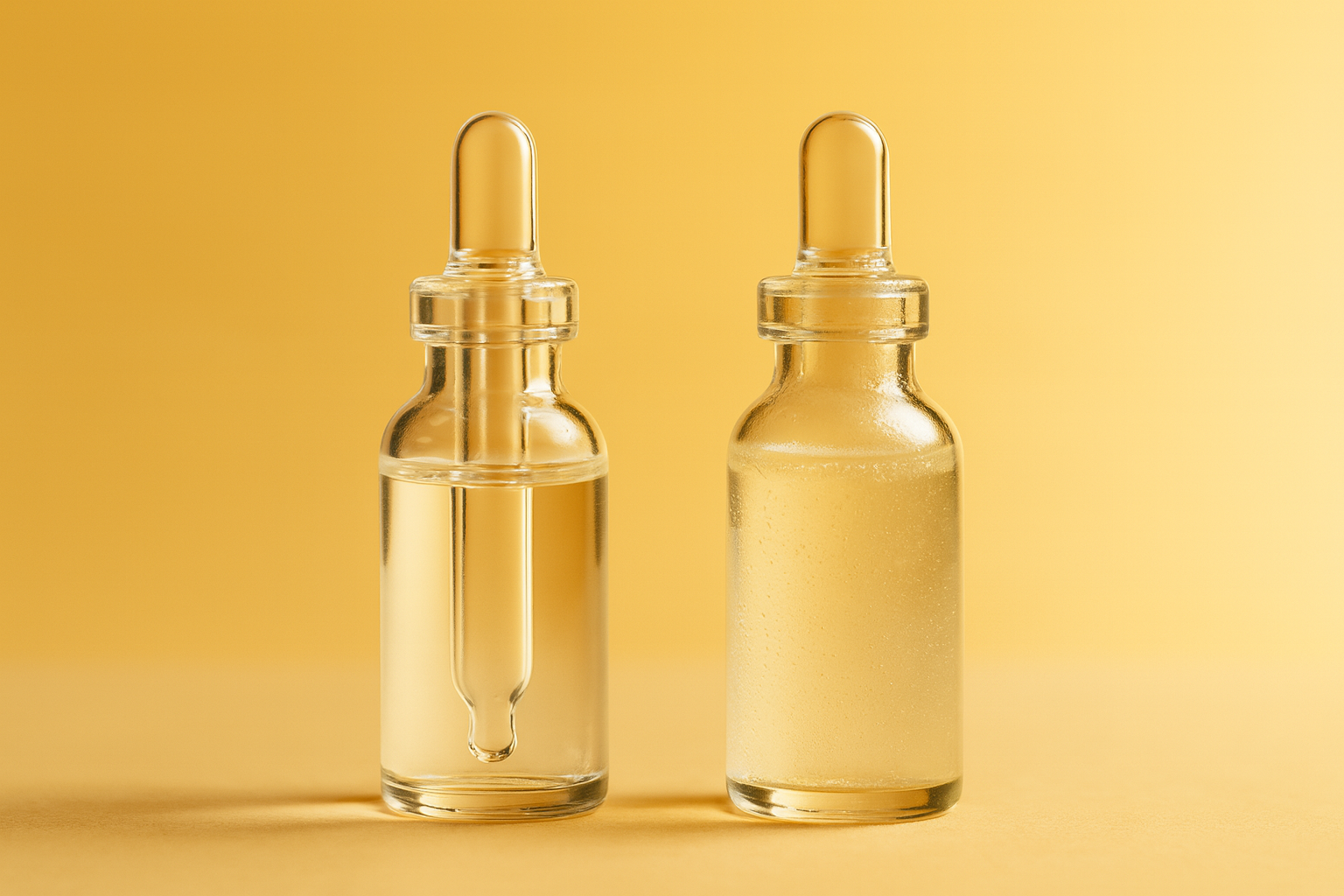
Clear on the left, aggregated on the right. Most aggregation is invisible; by the time you can see it, a lot has happened.
The chemistry, and why the technique matters
Freeze-drying exists to remove water, because water drives the reaction. In solid-state stability work on human insulin, water content governed the kinetics of degradation, with the dry material far more stable than the same peptide in solution.[2] Pharmaceutical freeze-drying is built on that principle.[3] Reconstitution restarts the clock.
Why the stream goes down the wall. A proteome-scale study found that agitation and contact with plastic surfaces promote protein aggregation.[4] This is not a subtle artefact: shaking is how researchers induce aggregation on purpose. Aggregates matter because in licensed protein products they are the attribute regulators watch most closely, and reviews link aggregate content to immunogenicity risk.[5]
Why some peptide never reaches your syringe. Cationic peptides adsorb measurably to glass and plastic surfaces.[6] The effect matters most at low concentrations, where the container surface claims a larger share of the total.
Why the preservative is a trade-off. Benzyl alcohol is one of the antimicrobial preservatives used in multi-dose protein and peptide products,[7] and multi-dose containers carry a preservative because they get entered more than once.[8] A 2022 study then worked out the molecular mechanism by which that same class of excipient drives aggregation in parenteral peptide formulations.[9] The ingredient protecting the vial from microbes is a documented aggregation trigger for what is dissolved in it.
Why the fridge, and not the freezer. Deamidation is the main chemical route for many peptides in neutral aqueous solution, pinned down decades ago in growth hormone releasing factor analogues.[10] A 2025 study measured solution-state degradation of semaglutide against pH, buffer, molarity and temperature, and all four moved the result.[11] Freezing is not a pause button: freezing-induced aggregation is driven in part by a pH shift as the solution concentrates during ice formation.[12]
What no technique can fix
Every number on this page assumes the vial contains the stated mass at the stated purity. For research-use material nothing independently establishes that, and no reconstitution technique compensates for a vial that does not hold what the label says.
This article is for research and informational purposes only and is not intended to diagnose, treat, cure, or prevent any disease. The peptides discussed here are sold for research use only and are not for human consumption. Nothing in this article constitutes medical advice. Consult a qualified clinician before making changes to a health, training, or supplementation protocol.
References
- Refrigerated multi-dose insulin vials remain sterile through 6 months of use.. The Journal of small animal practice, 2023.
- Solid-state stability of human insulin. I. Mechanism and the effect of water on the kinetics of degradation in lyophiles from pH 2-5 solutions.. Pharmaceutical research, 1996.
- Applications of Freezing and Freeze-Drying in Pharmaceutical Formulations.. Advances in experimental medicine and biology, 2018.
- A proteome scale study reveals how plastic surfaces and agitation promote protein aggregation.. Scientific reports, 2023.
- Protein aggregation and immunogenicity of biotherapeutics.. International journal of pharmaceutics, 2020.
- Adsorption of cationic peptides to solid surfaces of glass and plastic.. PloS one, 2015.
- Antimicrobial Preservatives for Protein and Peptide Formulations: An Overview.. Pharmaceutics, 2023.
- Antimicrobial preservative use in parenteral products: past and present.. Journal of pharmaceutical sciences, 2007.
- Molecular Mechanism of Antimicrobial Excipient-Induced Aggregation in Parenteral Formulations of Peptide Therapeutics.. Molecular pharmaceutics, 2022.
- Degradation of growth hormone releasing factor analogs in neutral aqueous solution is related to deamidation of asparagine residues. Replacement of asparagine residues by serine stabilizes.. International journal of peptide and protein research, 1991.
- Effect of pH, buffers, molarity, and temperature on solution state degradation of semaglutide using LC-HRMS: A preformulation protocol for peptide drug delivery.. European journal of pharmaceutics and biopharmaceutics : official journal of Arbeitsgemeinschaft fur Pharmazeutische Verfahrenstechnik e.V, 2025.
- Freezing-induced protein aggregation - Role of pH shift and potential mitigation strategies.. Journal of controlled release : official journal of the Controlled Release Society, 2020.