Every melanotan II thread on the internet ends in the same place: a mirror selfie, a tan line, and a caption implying the injections did it. What almost none of those threads show is the actual documented harm, which is not skin cancer and is not the thing most people warn about. A 2026 systematic review pulling together 68 studies on self-tanning agents ties unregulated melanotan I and II use to rhabdomyolysis, renal infarction, and priapism.[1] That is the finding. The before-and-after photo is not evidence of anything except pigment.
What backs the tanning claim
Melanotan II, alongside melanotan I, is one of the agents that review names as dominant in current unregulated cosmetic tanning use, next to dihydroxyacetone (the active ingredient in ordinary self-tanner).[1] That single sentence is doing more work than it looks like, because it is also close to the ceiling of what the peer-reviewed literature says about melanotan II specifically.
The published evidence on melanotan II sits inside that broader self-tanning literature, which the review describes as having variable study outcomes and non-standardized reporting rather than a dedicated body of large controlled trials.[1] What exists is a patchwork, synthesized after the fact by reviewers rather than generated by anyone running a proper program of studies on the compound itself.
Melanotan II’s actual research history looks thin next to its cousin. Afamelanotide, a related melanocortin agonist, went through two multicenter, randomized, double-blind, placebo-controlled trials, one enrolling 74 patients in the European Union and a second enrolling 94 in the United States, before being approved for erythropoietic protoporphyria, a rare disorder that causes severe skin pain on light exposure.[2] Melanotan II has never been run through anything comparable.
68 studies synthesized in the systematic review that names melanotan II PMID 41890775
How melanotan II works, and how much of that is proven
Melanotan II is not a clean drug. A 2022 medicinal chemistry paper describes it plainly as “a potent and unselective agonist of human MCRs,” meaning it switches on several melanocortin receptor subtypes at once rather than targeting one.[3] That non-selectivity is the whole story of why the compound does more than tan skin, and also why it is a blunt instrument.
The tanning mechanism itself is solid pharmacology. Melanocortins bind the MC1 receptor on melanocytes and activate the cAMP pathway that drives UV-induced pigmentation, the same pathway a fair-skinned person’s own skin uses (poorly) when it tries to tan in the sun.[4] That part is not in dispute.
What is murkier is everything melanotan II does beyond skin. Central alpha-MSH and melanocortin receptor signaling is understood to help regulate appetite, and that is one of the central-nervous-system effects attributed to non-selective agonists like this one.[5] Notice what that sentence does not claim: it does not say melanotan II’s reported effects on arousal are established science. The review behind that citation covers appetite regulation. It does not address sexual arousal at all, and I am not going to borrow a mechanism from one outcome and apply it to another just because they both run through the same receptor family.
The dosing question nobody can honestly answer
Ask a melanotan II forum what dose to use and you will get a confident number. Ask the peer-reviewed literature the same question and you get silence. Every attempt to trace a specific published human dosing regimen for melanotan II back to a real citation came up empty here. That is not a minor gap. It means the dosing schedules circulating online did not come from a clinical study that anyone can check.
What compounds this problem: nobody regulates the product itself. Unregulated vials sold online as melanotan II are not the same material used in any laboratory study, and they carry no verified dose or purity standard. A buyer has no way to confirm that a vial contains what the label says, at the concentration the label says, made under conditions that would pass a pharmacy inspection.
Bottom line on dosing: there is no verified published human dosing regimen for melanotan II to point to, and no way to confirm what a gray-market vial contains. Both gaps sit on top of each other.
The real safety signal, and it isn’t melanoma
Here is the contrarian part. The internet’s dominant safety narrative about melanotan II is that it darkens moles and could hide a melanoma. That is a plausible-sounding story. It is also not what the available literature documents. Two specific claims get repeated constantly and neither one traces back to a citable source in the material available for this article:
- “Trials reported nausea and erections as the top side effects.” No pilot-trial data on melanotan II turned up here to back that framing.
- “Case reports tie melanotan use to new or changing moles.” No case-report evidence connecting melanotan specifically to nevus change or melanoma surfaced either.
I am dropping both rather than repeating them on the strength of forum consensus.
What the systematic review does document is more concrete and, frankly, more alarming:
The real signal: unregulated melanotan I and II use has caused serious adverse effects including rhabdomyolysis, renal infarction, and priapism, according to the 2026 review, alongside a persistent lack of long-term safety data.[1]
None of these are cosmetic side effects, and none of them show up in a before-and-after photo:
- Rhabdomyolysis: muscle tissue breaking down and releasing its contents into the bloodstream.
- Renal infarction: tissue death inside a kidney caused by a blocked blood supply.
- Priapism: a prolonged, painful erection that counts as a genuine urological emergency requiring treatment.
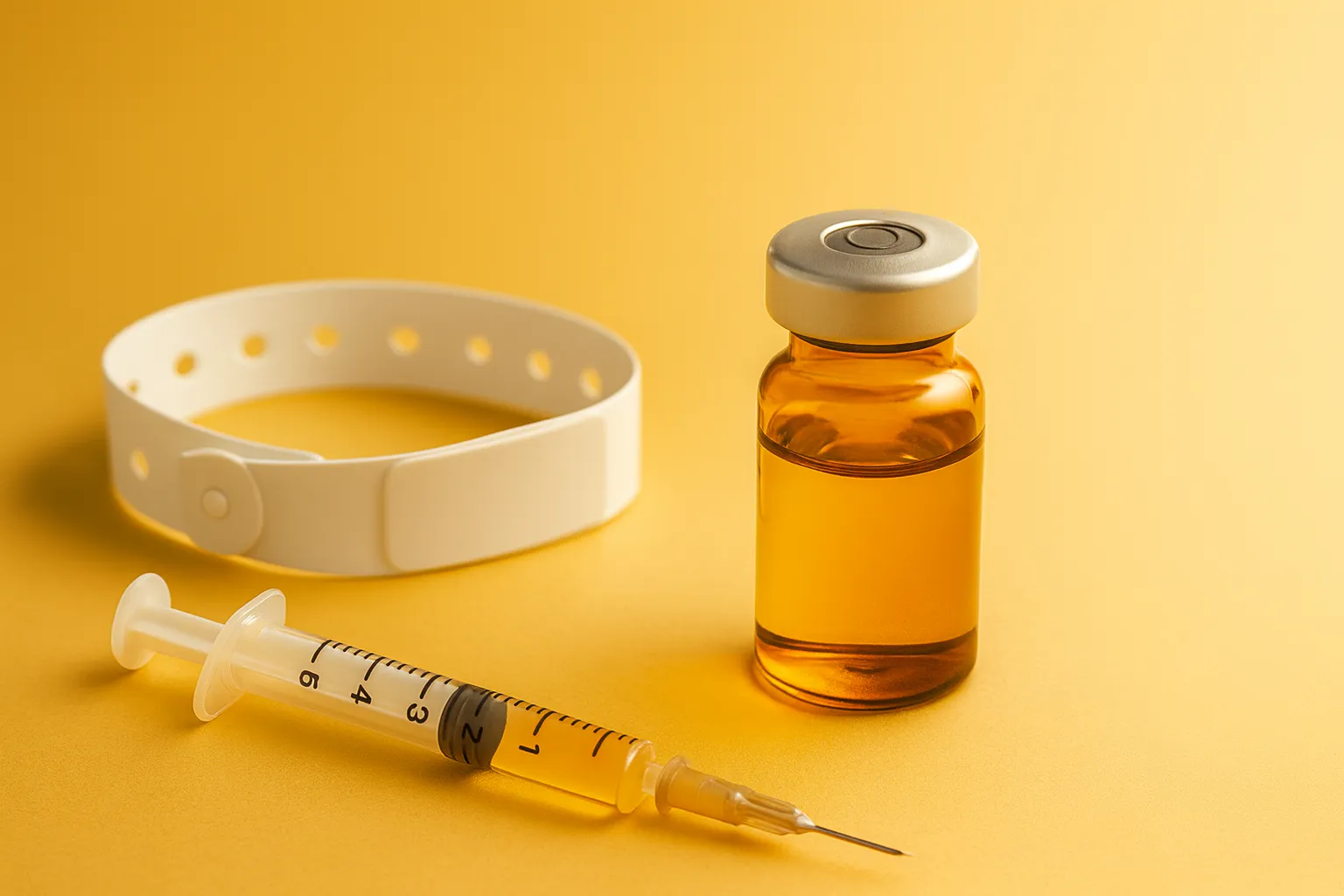
The compound's own safety data comes largely from emergency department case reports instead of any clinic.
The same review notes that its underlying studies suffer from limited long-term safety data and inconsistent reporting.[1] Nobody has run the multi-year safety follow-up that would tell a repeat user what years of exposure does. That is not a reassuring unknown. It is an unknown because nobody with regulatory standing has been made to answer it.
Melanotan II next to its regulated relatives
Melanotan II has two better-behaved relatives, and putting all three side by side is the fastest way to see what “unregulated” costs a user.
Three melanocortin agonists, three different evidence bases
| Compound | Primary effect | Trial and regulatory status | Source |
|---|---|---|---|
| Melanotan II | Skin tanning (non-selective receptor activation) | No dedicated large controlled trials; sold unregulated online | Systematic review, 68 studies |
| Afamelanotide | Photoprotection in erythropoietic protoporphyria | Two placebo-controlled trials (n=74 EU, n=94 US); approved and marketed | NEJM, 2015 |
| Bremelanotide | Hypoactive sexual desire disorder | Two randomized phase 3 trials (RECONNECT), 1.75 mg subcutaneous as needed | Obstetrics and Gynecology, 2019 |
Regulatory and trial status as documented in the cited sources.
Afamelanotide has gone through the trials and the regulatory marketing process. It is sold in Italy and Switzerland for erythropoietic protoporphyria patients, and it got there through phase II and III development, a path a gray-market supplier never takes.[6] The same 2013 review that documents that path also calls out, by name, “counterfeit chemicals, ‘Melanotans’” being sold online for tanning ahead of any formal approval, which is a striking thing to find written into the peer-reviewed record over a decade ago.[6]
Bremelanotide took the other branch of melanotan II’s non-selective activity, the one connected to sexual arousal, and turned it into a single-purpose drug. It was tested in two randomized, placebo-controlled phase 3 trials (RECONNECT) at a defined 1.75 mg subcutaneous as-needed dose, in premenopausal women with hypoactive sexual desire disorder, with efficacy and safety as coprimary endpoints.[7] Whatever a melanotan II user experiences anecdotally along those lines, there is now a drug that isolated that one effect and put it through the process melanotan II itself never completed.
That is the real comparison. Melanotan II is the unrefined original: several receptor effects bundled into one shot, none of them individually verified to a regulator’s satisfaction. Afamelanotide and bremelanotide are what happens when someone takes one piece of that same pharmacology and carries it through proof. If you have read about the thin, contested tendon-repair evidence behind TB-500, the pattern here will look familiar: a compound with a plausible mechanism and a devoted online following, standing well ahead of what anyone has measured.
What would change this picture
A 2026 systematic review of the self-tanning literature concludes that further clinical studies are still needed to evaluate long-term safety and efficacy, which reflects how little large randomized-trial evidence exists for melanotan II’s cosmetic tanning effect.[1] Until that changes, what’s on record is a tanning mechanism that checks out biochemically, a research trail thinner than its reputation, and a documented pattern of serious, non-cosmetic harm in the people who inject it anyway.
None of that shows up in a before-and-after photo. That is the point.
If you are weighing melanotan II against other peptides with more or less human trial support, the honest version of this story is narrower and less exciting than “banned peptide, stay away”: a non-selective drug, two of its effects since spun off into properly tested medicines, and a safety record built mostly from emergency-room case reports rather than a clinic.
This article is for research and informational purposes only and is not intended to diagnose, treat, cure, or prevent any disease. The peptides discussed here are sold for research use only and are not for human consumption. Nothing in this article constitutes medical advice. Consult a qualified clinician before making changes to a health, training, or supplementation protocol.
References
- Insights into Tanning Biology and Tanning Products.. The Journal of clinical and aesthetic dermatology, 2026.
- Afamelanotide for Erythropoietic Protoporphyria.. The New England journal of medicine, 2015.
- CLIPSing Melanotan-II to Discover Multiple Functionally Selective hMCR Agonists.. Journal of medicinal chemistry, 2022.
- The melanocortin 1 receptor and the UV response of human melanocytes--a shift in paradigm.. Photochemistry and photobiology, 2008.
- Neuropeptide Y, alpha-melanocyte-stimulating hormone, and monoamines in food intake regulation.. Nutrition (Burbank, Los Angeles County, Calif.), 2005.
- A review and update on melanocyte stimulating hormone therapy: afamelanotide.. Journal of drugs in dermatology : JDD, 2013.
- Bremelanotide for the Treatment of Hypoactive Sexual Desire Disorder: Two Randomized Phase 3 Trials.. Obstetrics and gynecology, 2019.