Ask what oxytocin does for a person and the honest answer depends entirely on the route into their body. Give it intravenously during labor and the trial record is about as strong as obstetric medicine gets. Spray it up someone’s nose for trust, bonding, or anti-aging and the record mostly collapses on replication. Both preparations share a name and a molecular structure. They do not share an evidence base, and treating oxytocin as one substance with one benefit profile is the central mistake in how it gets discussed outside a delivery room.
The delivery-room evidence and the nasal-spray evidence are not the same literature
Oxytocin’s oldest job is still its best-supported one. Given intravenously, it is a standard first-line uterotonic for labor induction, labor augmentation, and prevention of postpartum hemorrhage, and multiple Cochrane systematic reviews of randomized trials back that use.[1] This is not a single study with a flattering result. It is decades of accumulated trial data on a drug doctors give to patients routinely, with a dose, a route, and a monitored setting attached to every administration.
Walk away from the IV line and into the nasal-spray literature, and the picture changes fast:
- The founding “trust” finding did not hold up. Kosfeld and colleagues’ widely cited 2005 result, that a single dose of intranasal oxytocin made people transfer more money to strangers in an investment game, failed to replicate in a large, pre-registered, double-blind study powered above 95 percent.[2]
- The largest, best-designed autism trial found nothing. A 2021 phase 2 trial enrolled 290 children and adolescents with autism spectrum disorder, 146 on oxytocin and 144 on placebo, and ran for 24 weeks. It found no significant difference between groups on its primary social-withdrawal measure or on any secondary outcome.[3]
290 children and adolescents in the largest oxytocin-autism trial, which found no benefit over placebo PMID 34644471
That is not a fringe result from an underpowered lab study. It is the single largest, most carefully designed test of intranasal oxytocin’s signature social claim, and it came back null.
Why the nasal-spray literature keeps disappointing itself
The replication problem has a mechanical explanation, and it is not subtle once you look at the pharmacokinetics. A widely cited review found that very little intranasally applied oxytocin reaches cerebrospinal fluid, even as peripheral blood concentrations rise far above normal.[4] You are flooding the bloodstream and barely dosing the brain, which is a different proposition entirely from an IV line delivering the peptide to receptors sitting right on the uterus.
That pharmacokinetic gap also undercuts the aggregate social-cognition data. A 2018 meta-analysis pooling 17 randomized trials and 466 participants across neurodevelopmental disorders found no significant effect of intranasal oxytocin on emotion recognition and only a small effect on theory of mind, nowhere near the dramatic single-study findings that built the compound’s reputation.[5]
There is a second, quieter problem that sits underneath all of this: the direction of causation in human observational data. Studies linking higher circulating oxytocin to things like social trust or relationship satisfaction cannot establish that oxytocin caused those outcomes, because bonding behavior itself raises oxytocin release. Holding hands raises oxytocin. So does a good conversation. Treating the hormone level as the cause rather than a downstream readout is a basic interpretive error, and it shows up constantly in how this research gets summarized.
The practical problem with nasal-spray oxytocin: the dose reaching the brain and the dose reaching the bloodstream are not the same number, and most of the behavioral claims assume they are.
One receptor is well understood. The other is not
Oxytocin’s uterotonic effect works through a genuinely well-characterized peripheral mechanism: it binds myometrial oxytocin receptors, raises intracellular calcium, and triggers smooth-muscle contraction.[6] This is textbook receptor pharmacology, confirmed, mapped, and exploited in obstetric practice for decades.
The central story is thinner. A rat study found that oxytocin reduces fear through sustained changes in central amygdala neuronal activity during social buffering, a circuit-level mechanism worked out in the animal brain.[7] That is a different kind of evidence than the handful of human imaging studies showing oxytocin dampens amygdala reactivity to fear, imaging that cannot resolve what happens at the level of a single neuron or receptor. One mechanism is characterized down to the signaling cascade. The other is inferred from behavior and extrapolated from rodents.
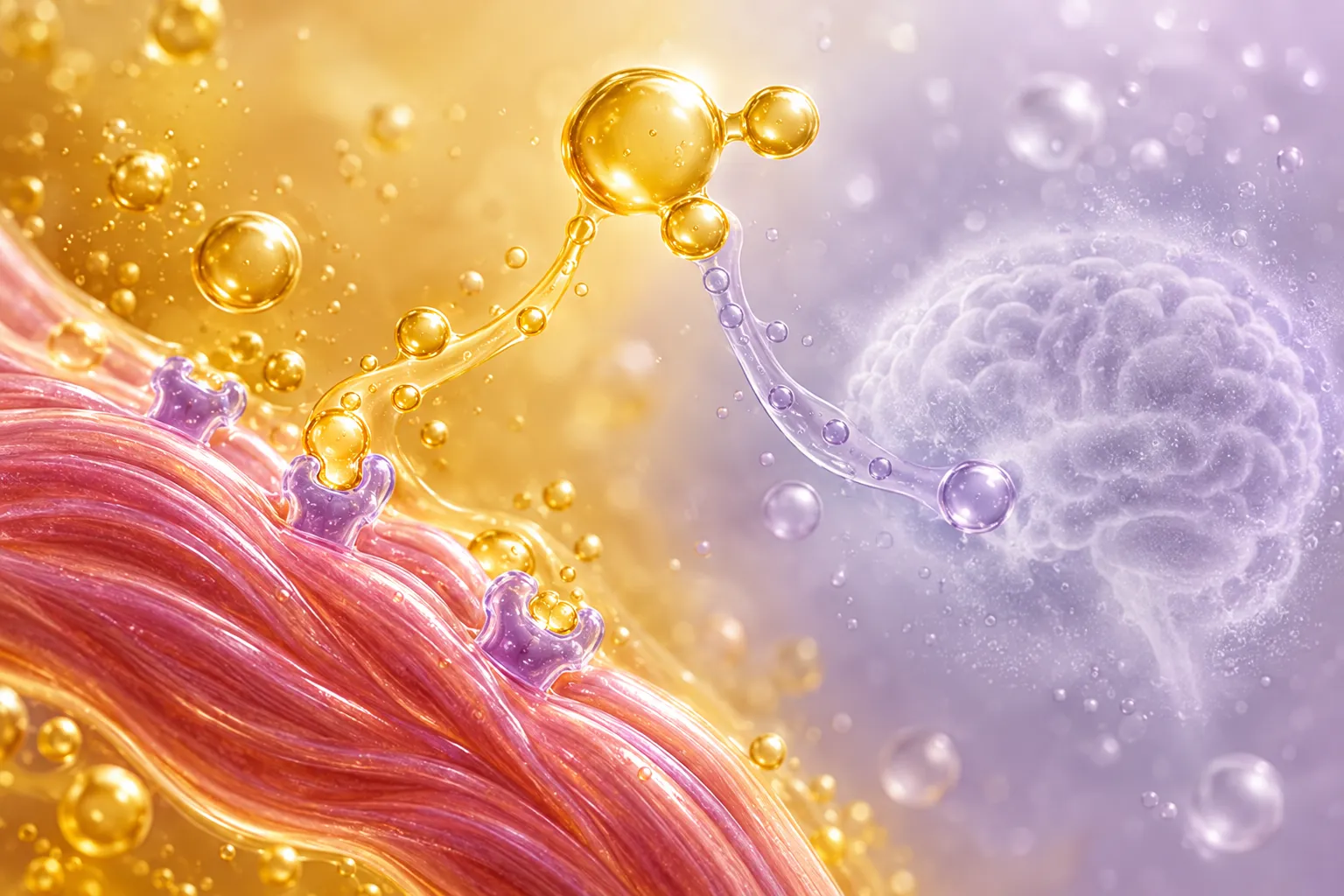
One receptor pathway is mapped. The other is still being argued over.
The “longevity” claim is not baseless, but it rests on one small trial
Here is the part that should surprise anyone who assumes oxytocin’s anti-aging reputation is pure marketing: it is not built on nothing. It traces to a real mechanistic finding, and that finding has, unusually, already been tested once in people.
The origin point is a 2014 mouse study: circulating oxytocin declines with age, and restoring it improved aged muscle stem cells’ regenerative capacity through MAPK/ERK signaling.[8] The authors themselves flagged that oxytocin is already an FDA-approved drug, which is presumably why someone eventually tried the obvious next step.
That next step turned out to be a genuine, if tiny, human pilot. A 2021 double-blind, placebo-controlled trial gave 21 older adults with sarcopenic obesity intranasal oxytocin, 24 IU four times daily, for 8 weeks. The oxytocin group gained 2.25 kg more lean body mass than placebo and saw a larger drop in LDL cholesterol, with no significant adverse events.[9]
2.25 kg extra lean mass gained over 8 weeks in the only human pilot trial of oxytocin for age-related muscle loss PMID 34029521
So the claim “no human has ever tested this” is wrong. The more honest claim is “one pilot study of 21 people tested this, found a real signal, and nobody has followed it up.” Searching for a larger or longer registered trial on oxytocin and muscle aging turned up nothing. That absence does not disprove the finding. It means the mouse-to-human bridge has exactly one plank in it, and that plank has not been load-tested at any scale beyond 21 people over 8 weeks.
What oxytocin's evidence looks like, by use case
| Use case | Route | Key trial | Result |
|---|---|---|---|
| Labor and postpartum hemorrhage | Intravenous | Cochrane synthesis of randomized trials | Established, reduces blood loss |
| Trust and social cognition | Intranasal | Pre-registered replication | No effect on trust behavior |
| Autism core social deficits | Intranasal | 290-person phase 2 RCT | No benefit over placebo |
| Age-related muscle loss | Intranasal | 21-person pilot RCT | Lean mass up 2.25 kg, unreplicated |
Evidence tier drops sharply the further you get from the delivery room.
The doses in the literature are research parameters, not a protocol
None of the numbers below are a recommendation. They are what investigators used to answer a specific research question, under supervision, with monitoring the home user does not have.
- Obstetric infusion. A review of regimens across 12 countries found starting rates as low as 0.06 international units per hour, escalated under hospital monitoring to a maximum ranging from 0.90 to 3.60 IU per hour.[10] That is a titrated hospital protocol, adjusted in real time against uterine response and fetal heart rate, with nothing fixed about it.
- Intranasal research dosing. Trials testing oxytocin’s effect on amygdala reactivity have used single doses ranging from 12 to 48 international units, with 24 IU the most common choice across the social-cognition literature.[11] That range was chosen empirically to find a measurable brain-imaging effect, not derived from any confirmed therapeutic window.
Side effects: mild in the data, understudied outside it
Obstetric oxytocin’s risk profile is well characterized precisely because it has been used under supervision for so long. A meta-analysis found that continuing an intravenous oxytocin infusion through labor carries a significantly higher rate of uterine tachysystole and abnormal fetal heart rate patterns than discontinuing it once labor is established, which is exactly why infusions are titrated and monitored rather than left running on a fixed schedule.[12]
The intranasal safety data looks reassuring on its face, with an important caveat. A meta-analysis of long-term intranasal oxytocin trials in autism found mild adverse events, including nasal discomfort and tiredness, occurring at similar rates in the oxytocin and placebo groups, though few trials followed participants beyond a few months.[13]
A short trial finding no safety signal and a lifetime of safe use are not the same claim, and nobody has the data to write the second one yet.
The warning that matters here: obstetric oxytocin is safe precisely because it is dosed and watched by someone trained to stop it. None of that infrastructure exists for someone spraying a research dose up their own nose at home.
Where oxytocin sits next to its closest relative
Oxytocin is not the only neuropeptide with this exact problem. Vasopressin, its closest structural relative, has its own randomized trial testing both hormones across a battery of social-cognitive tasks, and that trial found no main effect of either one, with equivalence testing confirming the study had enough power to detect a real absence of effect rather than just a false negative.[14] The replication crisis in this corner of neuroscience is not an oxytocin problem specifically. It is a problem with how an entire family of nonapeptides got oversold on small, underpowered, single-site studies before anyone ran the large, pre-registered version.
That large pre-registered version is exactly what finally moved the Kosfeld trust-game question off the table: the same 2020 replication that found no trust effect was explicitly designed with more than 95 percent power, the kind of study this literature needed a decade earlier.[2] If there is a lesson in oxytocin’s last twenty years of research, it is that a single elegant small study and a boring, overpowered replication are not the same tier of evidence, no matter which one got the magazine cover.
Compare that to interventions people reach for with actual longevity-relevant human trial data behind them, like structured exercise or caloric restriction protocols. Those rest on a far larger and more direct evidence base than oxytocin’s single rodent aging study and its one 21-person human follow-up. Oxytocin is not nothing. It is also nowhere close to being in that league yet.
So the answer to “does oxytocin work” is not yes or no. It is: for which job, through which route, backed by how many patients. Through an IV line in a delivery room, it works, repeatedly, at scale. Through a nasal spray chasing trust, bonding, or a longer life, it is one interesting pilot study and a long list of studies that failed to repeat themselves.
This article is for research and informational purposes only and is not intended to diagnose, treat, cure, or prevent any disease. The peptides discussed here are sold for research use only and are not for human consumption. Nothing in this article constitutes medical advice. Consult a qualified clinician before making changes to a health, training, or supplementation protocol.
References
- Intravenous versus intramuscular prophylactic oxytocin for the third stage of labour.. The Cochrane database of systematic reviews, 2020.
- A registered replication study on oxytocin and trust.. Nature human behaviour, 2020.
- Intranasal Oxytocin in Children and Adolescents with Autism Spectrum Disorder.. The New England journal of medicine, 2021.
- Intranasal Oxytocin: Myths and Delusions.. Biological psychiatry, 2016.
- Intranasal oxytocin, social cognition and neurodevelopmental disorders: A meta-analysis.. Psychoneuroendocrinology, 2018.
- Oxytocin: its mechanism of action and receptor signalling in the myometrium.. Journal of neuroendocrinology, 2014.
- Social buffering in rats reduces fear by oxytocin triggering sustained changes in central amygdala neuronal activity.. Nature communications, 2024.
- Oxytocin is an age-specific circulating hormone that is necessary for muscle maintenance and regeneration.. Nature communications, 2014.
- Intranasal Oxytocin Improves Lean Muscle Mass and Lowers LDL Cholesterol in Older Adults with Sarcopenic Obesity: A Pilot Randomized Controlled Trial.. Journal of the American Medical Directors Association, 2021.
- How much synthetic oxytocin is infused during labour? A review and analysis of regimens used in 12 countries.. PloS one, 2020.
- Kinetics and Dose Dependency of Intranasal Oxytocin Effects on Amygdala Reactivity.. Biological psychiatry, 2017.
- Continued versus discontinued oxytocin after the active phase of labor: An updated systematic review and meta-analysis.. PloS one, 2022.
- Systematic review and meta-analysis of reported adverse events of long-term intranasal oxytocin treatment for autism spectrum disorder.. Psychiatry and clinical neurosciences, 2018.
- Null results of oxytocin and vasopressin administration across a range of social cognitive and behavioral paradigms: Evidence from a randomized controlled trial.. Psychoneuroendocrinology, 2019.