A stall reads as proof the drug stopped working. That is the instinct behind most “is my retatrutide plateauing” posts, and the trial record says otherwise.
In the one dose-ranging study that measured this drug’s weight-loss curve past six months, the group on the highest dose gained more ground between week 24 and week 48 than any lower dose group did[1]. That is not what a flattening curve looks like. If retatrutide plateaus on treatment, nobody has published the data showing it, at any dose, at any week.
What a 48-week trial recorded
Jastreboff and colleagues ran a double-blind, placebo-controlled phase 2 trial in 338 adults with obesity, randomizing them to weekly retatrutide at 1 mg, 4 mg, 8 mg, or 12 mg, or to placebo, for 48 weeks[1]. The primary endpoint was weight change at 24 weeks. Weight change at 48 weeks was secondary, and that second measurement is the one that matters for a plateau question.
In the 12 mg arm, mean weight loss went from 17.5% of body weight at 24 weeks to 24.2% at 48 weeks[1]. That is a 6.7 percentage-point jump in the second half of the trial, the kind of acceleration a tail-off does not produce.
6.7 pp how much further the 12 mg group's average weight loss grew between week 24 and week 48 PMID 37366315
The dose groups that slowed down, and the one that didn’t
Here is the part that gets missed when people pull just the 24.2% headline number. Every lower dose in the same trial shows a smaller late-trial gap than the 12 mg group does[1]:
Weight loss by dose, week 24 versus week 48
| Dose | Week 24 | Week 48 | Gap |
|---|---|---|---|
| 1 mg | -7.2% | -8.7% | 1.5 pp |
| 4 mg | -12.9% | -17.1% | 4.2 pp |
| 8 mg | -17.3% | -22.8% | 5.5 pp |
| 12 mg | -17.5% | -24.2% | 6.7 pp |
Least-squares mean percentage change in body weight, same 48-week phase 2 trial.
The pattern runs backward from what a simple “every dose eventually plateaus” story would predict. The lowest dose shows the smallest late gain, almost flat by comparison, while the highest dose is still accelerating relative to its own earlier measurement. Whatever is happening physiologically, it has not finished happening by week 48 in the people taking the most drug.
For more on what that dosing schedule looked like week to week, see Retatrutide’s trial dosing ladder, and why it is not a how-to.
Why a rising average doesn’t rule out an individual stall
None of this proves that no individual participant plateaued, since a group mean cannot rule that out. The trial reports a group mean at two fixed visits rather than a continuous trajectory for any one person, and a rising average is perfectly compatible with some participants leveling off early while others kept dropping weight through week 48.
That distinction matters for anyone reading their own data against a trial’s. A single person’s curve and a dose group’s average answer different questions, a point covered in more depth in Retatrutide Results: The Trial Average Nobody’s Posting.
There’s also a titration wrinkle. Participants were not started directly on their assigned target dose: everyone above 1 mg began on a lower initial dose and was titrated upward over the trial, so a stall early in treatment can coincide with still being below the eventual target dose[1]. That is not the drug hitting a ceiling.
The titration trap: if you are still climbing the dose ladder, a flat week or two is not evidence of anything except being partway up the ladder.
The hormone story people reach for, and what it’s missing
The “ghrelin and leptin are fighting back” explanation for a stall is popular, and it is borrowed from a different body of evidence entirely. Sumithran and colleagues followed 50 overweight or obese adults through a 10-week very-low-energy diet that produced a mean 13.5 kg loss, then rechecked their appetite-regulating hormones a year later. Those hormones, including leptin, had still not returned to pre-diet levels[2]. That finding is real and well established, and it comes from ordinary dieting.
No published retatrutide trial has reported ghrelin or leptin levels across its treatment period. Whether the same hormonal rebound happens on a drug built specifically to counter appetite hormones, rather than on a diet that leaves the body to set its own terms, is simply untested in the human data that exists.
There is a mechanistic reason to think it might play out differently. Retatrutide activates glucagon receptors on top of GLP-1 and GIP receptors, and a 2023 review in the Hungarian medical journal Orvosi Hetilap describes glucagon’s role in energy expenditure and appetite regulation as the rationale for adding that third target[3]. Tirzepatide, by contrast, is a dual GIP and GLP-1 agonist with no glucagon-receptor activity at all.
If glucagon’s energy-expenditure effect is real and large enough to matter, retatrutide’s extra receptor is the one place in this drug class built to fight the metabolic slowdown that usually accompanies weight loss, rather than just suppressing appetite harder. Nobody has measured whether it does.
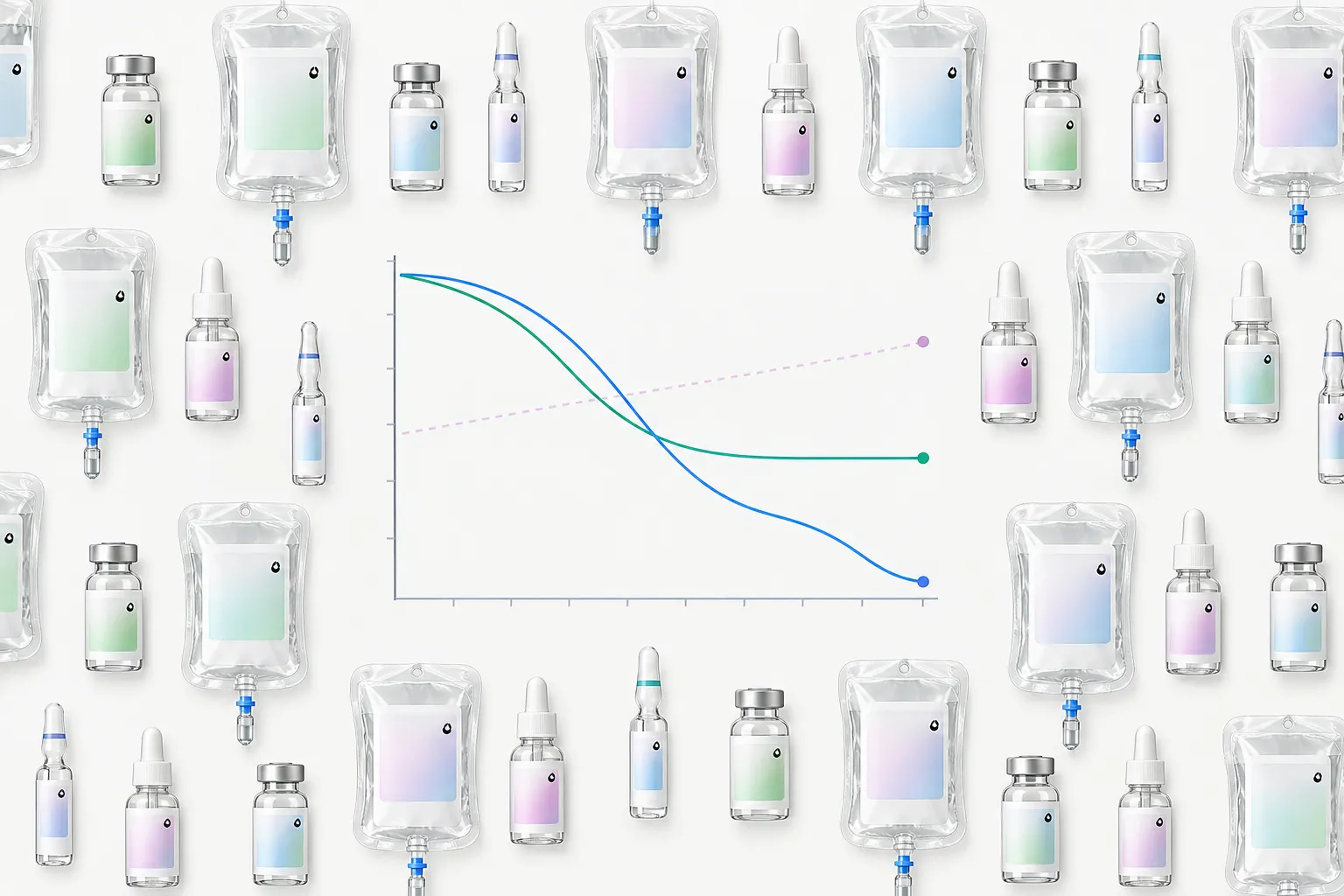
The trial's own curve had not leveled off. Whether the body's hunger signals had started fighting back on this drug is unmeasured.
What the trial doesn’t tell us
Be precise about the limits here. No retatrutide trial was designed to explain why an individual’s weight loss slows, so none of them can separate a true physiological plateau from a bad week of eating, water retention, or ordinary measurement noise.
And the published phase 2 report stops at 48 weeks. It cannot say whether the 12 mg curve, still rising at that final measurement, eventually flattens at week 60 or week 90 or never does on this dose, because nobody has published data past the point where the trial ended[1].
What a stall at week 12 or week 20 means
Two things follow from this, and neither is advice.
- A stall before week 48 is not evidence the drug stopped working. The trial’s own highest-dose group had not leveled off by that point, so an individual plateauing earlier is not replicating a pattern the trial itself showed.
- Blaming a specific hormone for a specific stall goes beyond the data. The ghrelin and leptin rebound is well documented after ordinary dieting. It has never been measured in a retatrutide trial.
Bottom line: the evidence supports “this drug’s own curve hadn’t flattened by the last point anyone measured it.” It does not support a specific physiological explanation for why any one person’s weight loss slowed.
What’s known about plateaus in this drug class
The plateau question that already has a real answer is a different one: not whether the curve flattens on treatment, but what happens after you stop. Berg and colleagues pooled 8 randomized trials with 2,372 participants and found that people who discontinued semaglutide or tirzepatide regained a mean of 9.69 kg, with the amount of regain proportional to how much weight they had lost in the first place[4].
9.69 kg mean weight regained after stopping semaglutide or tirzepatide, across 8 trials PMID 40186344
That is a documented, quantified plateau, just not the one most people asking about retatrutide have in mind. No trial has published whether retatrutide’s or tirzepatide’s on-treatment curve ever flattens. What is published, in detail, is that the regain after stopping either drug is large and roughly predictable[4].
The honest shape of the evidence, then, is lopsided. We know a lot about what happens when you stop a drug in this class. We know almost nothing yet about whether, or when, the curve flattens while you are still on it. A reported stall at week 16 is being read through a story the trials have not told, and if gastrointestinal tolerability rather than biology is driving it, Retatrutide Side Effects: Trial Findings and Evidence Limits covers what that same 338-person trial reported about adverse events.
This article is for research and informational purposes only and is not intended to diagnose, treat, cure, or prevent any disease. The peptides discussed here are sold for research use only and are not for human consumption. Nothing in this article constitutes medical advice. Consult a qualified clinician before making changes to a health, training, or supplementation protocol.
References
- Triple-Hormone-Receptor Agonist Retatrutide for Obesity - A Phase 2 Trial.. The New England journal of medicine, 2023.
- Long-term persistence of hormonal adaptations to weight loss.. The New England journal of medicine, 2011.
- [From GLP1 receptor agonists to triple hormone receptor activation supplemented with glucagon receptor agonism.].. Orvosi hetilap, 2023.
- Discontinuing glucagon-like peptide-1 receptor agonists and body habitus: A systematic review and meta-analysis.. Obesity reviews : an official journal of the International Association for the Study of Obesity, 2025.