If your vial is labeled 10 milligrams per milliliter, a 2.5 milligram dose is 25 units on a standard U-100 insulin syringe. If your vial is labeled differently, that number changes, because the unit count depends entirely on concentration. Get the concentration wrong and the unit count is wrong by whatever factor separates the two.
What you need before you draw up a dose
- A U-100 insulin syringe. Marked in units, where 100 units equal 1 milliliter of solution.
- The vial, with its concentration printed on the label in milligrams per milliliter.
- An alcohol swab for the vial stopper and injection site.
- A sharps container for the used syringe.
Compounded tirzepatide for injection is generally dispensed in a multi-dose vial, unlike the fixed-dose prefilled pens used for the FDA-approved products Zepbound and Mounjaro. Those pens deliver a single set dose per click. A vial does not, which is the entire reason the units question exists in the first place.
The concentration-to-units chart
The formula: units needed equal the dose in milligrams divided by the vial’s concentration in milligrams per milliliter, multiplied by 100.
The concentration printed on a compounded vial varies by pharmacy, so the same 2.5 milligram dose can require a very different number of units from one prescription to the next.
2.5 mg of tirzepatide, converted by concentration
| Concentration | Volume for 2.5 mg | Units on a U-100 syringe |
|---|---|---|
| 2.5 mg/mL | 1 mL | 100 units |
| 5 mg/mL | 0.5 mL | 50 units |
| 10 mg/mL | 0.25 mL | 25 units |
| 12.5 mg/mL | 0.2 mL | 20 units |
| 20 mg/mL | 0.125 mL | 12.5 units |
| 25 mg/mL | 0.1 mL | 10 units |
Units on a standard U-100 syringe, rounded to the nearest quarter unit.
Bottom line: there is no single correct answer to “how many units is 2.5 mg.” There is only the answer for your concentration. If your vial’s concentration is not one of these six, the same formula still applies: divide 2.5 by your concentration, then multiply by 100.
At the low end of that table, a 2.5 milligram dose eats an entire 1 milliliter syringe. That matters later, because the same concentration cannot practically deliver a 15 milligram maintenance dose without a 6 milliliter injection.
How to draw up and inject a 2.5 mg dose
Read the concentration on the vial label
Reading the concentration printed on the vial label before calculating units avoids the dosing errors that come from assuming a standard concentration. Do this every time, even with a refill from the same pharmacy. Compounding concentrations change between batches more often than people expect.
Calculate your units
Divide 2.5 by your concentration in mg/mL, then multiply by 100, and write the number down before you pick up the syringe.
Draw up the dose and clear the air
Air trapped in the syringe reduces the dose delivered and should be expelled before injecting. Draw slightly past your target number, tap the barrel to bring bubbles to the top, and push the plunger back to the exact unit mark.
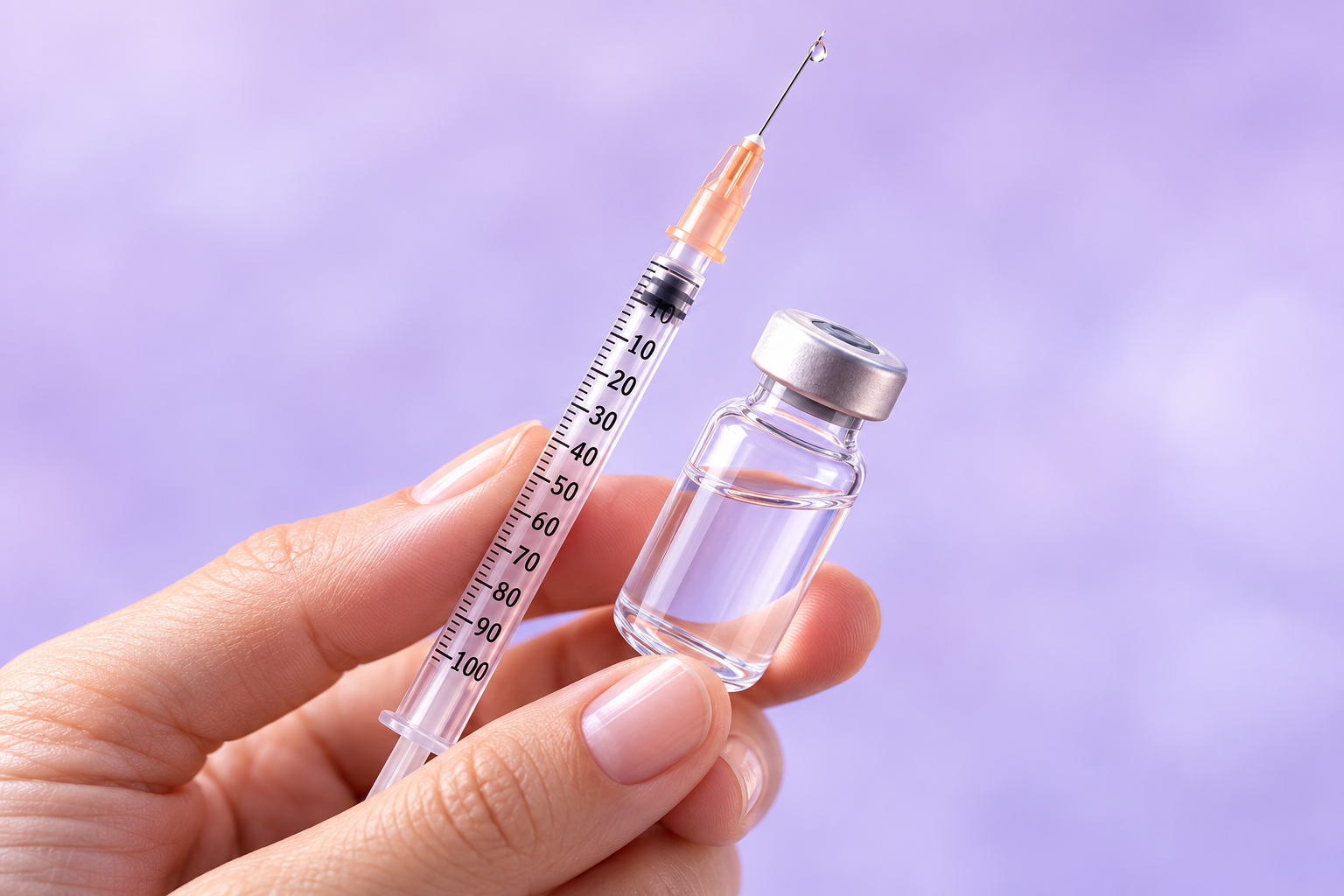
The syringe barrel is marked in units. That is the number you read off, whatever the milligram dose on the vial label says.
Choose and rotate your injection site
Rotating the injection site among the abdomen, thigh, and upper arm is standard practice for weekly subcutaneous injections. Using the same spot every week increases the odds of local irritation.
Inject and log the date
Inject subcutaneously at a 90-degree angle, hold for a few seconds, then withdraw. Log the date and the unit count somewhere you will check before next week’s dose.
What changes the number: concentration, vial, and the titration schedule
Tirzepatide’s titration schedule, used across its phase 3 trials, starts at 2.5 milligrams once weekly and increases in 2.5 milligram increments every four weeks until the assigned target dose is reached, according to the SURPASS-3 trial protocol comparing tirzepatide with insulin degludec in type 2 diabetes.[1] That is why 2.5 milligrams shows up on so many search results: it is the starting rung of a ladder, not a maintenance dose anyone stays on for long.
The obesity trial most people are thinking of when they ask this question, SURMOUNT-1, randomized adults with obesity or overweight and a weight-related condition to tirzepatide or placebo for 72 weeks, building toward maintenance doses of 5, 10, or 15 milligrams once weekly.[2] In SURMOUNT-1, adverse events caused treatment discontinuation more often at higher tirzepatide doses: 4.3% at 5 milligrams, 7.1% at 10 milligrams, and 6.2% at 15 milligrams, compared with 2.6% on placebo.[2]
Tirzepatide has an elimination half-life of about five days in humans, drawn from a population pharmacokinetic model pooling 19 studies, and that long half-life is what supports once-weekly dosing at any point on the schedule.[3]
That five-day half-life is also why the schedule cannot be sped up by taking two starting doses in one week. The drug has not cleared from the first dose by the time the second one would land.
What goes wrong with vial-and-syringe dosing
- The tenfold error. Confusing a dose in milligrams with a volume in milliliters, or misreading a syringe’s unit markings, can produce a tenfold dosing error. A syringe marked in 2-unit increments read as 1-unit increments, or vice versa, is the easiest way to get this wrong.
- No independent verification of the vial. Compounded vials have not gone through the FDA approval process that verifies sterility, stability, and labeled concentration the way Zepbound and Mounjaro pens have. The number on the label is only as reliable as the pharmacy that printed it.
- Escalating too fast. Gastrointestinal adverse events including nausea, diarrhea, and vomiting were the most commonly reported side effects in the SURMOUNT-1 trial, and they were more frequent during the early dose-escalation period than later in treatment.
Discontinuation due to adverse events, by tirzepatide dose (SURMOUNT-1)
- Placebo: 2.6
- 5 mg: 4.3
- 15 mg: 6.2
- 10 mg: 7.1
Percentage of participants who stopped treatment because of an adverse event, over 72 weeks.
Discontinuation was not a straight line up with dose. It rose from placebo to 5 milligrams to 10 milligrams, then dipped slightly at 15 milligrams, a trial-level pattern across hundreds of participants rather than a guarantee about any one person’s tolerance. It is one more reason a fast, self-directed climb up the dose ladder skips the exact process the schedule exists to manage.
5 days: tirzepatide's elimination half-life, the reason dosing is weekly at every step PMID 38356317
The pharmacology behind the starting dose
Tirzepatide activates both the GIP receptor and the GLP-1 receptor. That dual action was demonstrated directly in the molecule’s original discovery paper, where the compound (then labeled LY3298176) activated both GIP and GLP-1 receptor signaling in vitro and produced dose-dependent weight loss in mice beyond what a GLP-1-only comparator achieved.[4] Semaglutide, by contrast, is a selective GLP-1 receptor agonist with no GIP activity at all.
That single structural difference is most of the story of why the two drugs are dosed and marketed differently, and it shows up directly in outcomes: in a head-to-head trial, reductions in body weight were greater with tirzepatide than with semaglutide at every matched dose comparison.[5] Anyone weighing tirzepatide against semaglutide and retatrutide is really weighing how many receptors each molecule reaches.
Gradual titration is not unique to tirzepatide. In a dose-escalation study of exenatide, a related GLP-1 receptor agonist, gradually raising the dose cut the proportion of patients with dose-limiting nausea and vomiting roughly in half compared with starting at the full dose, without any loss of glucose-lowering effect.[6] Exenatide is a different drug from tirzepatide, but the underlying incretin pharmacology is close enough that the same logic applies: the gut has some capacity to adjust to a new signal, and a slow ramp gives it the chance to do so before the signal gets loud.
None of this tells you what concentration is sitting in your refrigerator. Only the label does that, and the formula above is only as good as the number you read off it.
Frequently asked questions
Does the unit count change if I use a different syringe? The formula assumes a standard U-100 syringe, where 100 units equal 1 milliliter. A syringe marked in a different scale would require a different conversion, though U-100 is the standard for insulin-style syringes used with compounded peptides.
Why isn’t 2.5 mg a real treatment dose? It generally is not, according to the titration protocol tirzepatide’s trials used: 2.5 milligrams is the starting rung, escalated in 2.5 milligram steps every four weeks toward a maintenance dose of 5, 10, or 15 milligrams.[1]
What if my vial’s concentration isn’t in the chart above? Use the formula directly: divide your dose in milligrams by your concentration in mg/mL, then multiply by 100. The table covers common round concentrations, but the arithmetic works for any number on the label.
This article is for research and informational purposes only and is not intended to diagnose, treat, cure, or prevent any disease. The peptides discussed here are sold for research use only and are not for human consumption. Nothing in this article constitutes medical advice. Consult a qualified clinician before making changes to a health, training, or supplementation protocol.
References
- Once-weekly tirzepatide versus once-daily insulin degludec as add-on to metformin with or without SGLT2 inhibitors in patients with type 2 diabetes (SURPASS-3): a randomised, open-label, parallel-group, phase 3 trial.. Lancet (London, England), 2021.
- Tirzepatide Once Weekly for the Treatment of Obesity.. The New England journal of medicine, 2022.
- Population pharmacokinetics of the GIP/GLP receptor agonist tirzepatide.. CPT: pharmacometrics & systems pharmacology, 2024.
- LY3298176, a novel dual GIP and GLP-1 receptor agonist for the treatment of type 2 diabetes mellitus: From discovery to clinical proof of concept.. Molecular metabolism, 2018.
- Tirzepatide versus Semaglutide Once Weekly in Patients with Type 2 Diabetes.. The New England journal of medicine, 2021.
- Effectiveness of progressive dose-escalation of exenatide (exendin-4) in reducing dose-limiting side effects in subjects with type 2 diabetes.. Diabetes/metabolism research and reviews, 2004.