The GLOW stack is sold on the premise that three tissue-repair peptides taken together do something none of them does alone. That premise has never been tested in a single human being. What exists instead is one topical trial in laser-resurfaced facial skin, a body of rat injury work, an eye-drop trial for corneal disease, and a three-letter name that quietly borrows credibility from all of it.
That is the entire evidential situation. The rest of this is the receipts.
What is in the GLOW stack
Three compounds, each with its own literature and, more importantly, its own species:
- GHK-Cu, a copper-binding tripeptide studied across models from nematodes to human skin, most recently in Caenorhabditis elegans, where it was reported to shift ageing measures through mitochondrial function and the DAF-16/SKN-1 pathways.[1] Three amino acids and a copper ion, and the newest data on it comes from a worm.
- BPC-157, a synthetic peptide from a gastric protein, studied almost entirely in rodent injury models.
- TB-500, a short fragment of thymosin beta-4 rather than the peptide itself. Sosne and colleagues showed in 2010 that thymosin beta-4’s biological activities map onto active sites contained in short sequences, which is the reason anyone sells a fragment at all.[2]
3 amino acids in GHK-Cu, the entire molecule PMID 42084774
Nothing above is a criticism yet. It is the setup for the only question that matters: what has each of these been given to, and for what outcome?
The GHK-Cu human evidence is topical, and it is about skin
The randomized human work on GHK-Cu that survives verification is a topical copper tripeptide complex applied to skin after CO2 laser resurfacing, published by Miller, Wagner, Baack and Eisbach in 2006.[3] A cream, applied to a wound, on a face.
That study design matters more than its result. A tripeptide painted onto abraded skin is doing something local to a barrier that has just been removed. It says nothing about a subcutaneous injection reaching a tendon or a joint, which is what the GLOW protocol proposes. We have written about that gap at length in GHK-Cu Peptide Injection: The Human Evidence Gap.
The mechanistic case is stronger than the clinical one. Reviews of cosmetic peptides describe GHK-Cu as acting on collagen and extracellular matrix signalling.[4] Plausible, and worth noting where the plausibility comes from: copper is the cofactor lysyl oxidase needs to crosslink collagen. A molecule that carries copper into skin has an obvious reason to influence matrix chemistry. It also means the interesting variable in these experiments may be the metal rather than the peptide, which is a question the cosmetic literature has been comfortable leaving open.
BPC-157’s evidence base is rodent, and its own reviewers say so
The 2025 systematic review of BPC-157 in orthopaedic sports medicine by Vasireddi and colleagues reached the conclusion that the field’s evidence rests on animal studies rather than human trials.[5] That verdict comes from the reviewers who went looking for a reason to use it.
The underlying rodent work is genuinely interesting:
- Muscle healing under corticosteroid suppression. Pentadecapeptide BPC 157 improved muscle healing that systemic corticosteroid treatment had impaired, in rats.[6] Healing a model of deliberately blocked healing is a stronger demonstration than healing a healthy animal.
- Vascular effects. A review of BPC 157 and blood vessels describes angiogenic responses in preclinical work.[7] Preclinical again, and rodent again.
The recurring problem: every quantitative claim made for BPC-157 in a stacking context comes from an animal that weighs 300 grams and received the compound in a controlled laboratory injury. Dose, route and timing in that setting carry no information about a human shoulder.
Our fuller treatment is in BPC-157: What It Is and How Researchers Use It.
The one randomized human trial behind TB-500 is an eye drop
Thymosin beta-4 has been through a randomized, placebo-controlled, double-masked phase III trial. It was a 0.1% ophthalmic solution, given to neurotrophic keratopathy patients, measured against corneal repair and comfort endpoints.[8]
0.1% the thymosin beta-4 concentration in its phase III corneal trial PMID 36613994
Read that sentence again before treating it as support for injecting a fragment into a hamstring. The compound is the full peptide, the route is a drop on the eye surface, the population is people with damaged corneal nerves, and the endpoint is epithelial healing.
The rest of the thymosin beta-4 file is mechanism and animals:
- It binds G-actin through the beta-thymosin/WH2 module and participates in cytoskeletal regulation.[9] Worth knowing that this module is an evolutionarily widespread actin-binding fold, so actin binding is closer to a housekeeping property than to a repair signal.
- Animal studies describe it as a multifunctional tissue repair and regeneration peptide.[10]
The comparison against BPC-157 is covered in TB-500 vs BPC-157: Which Has the Better Evidence.
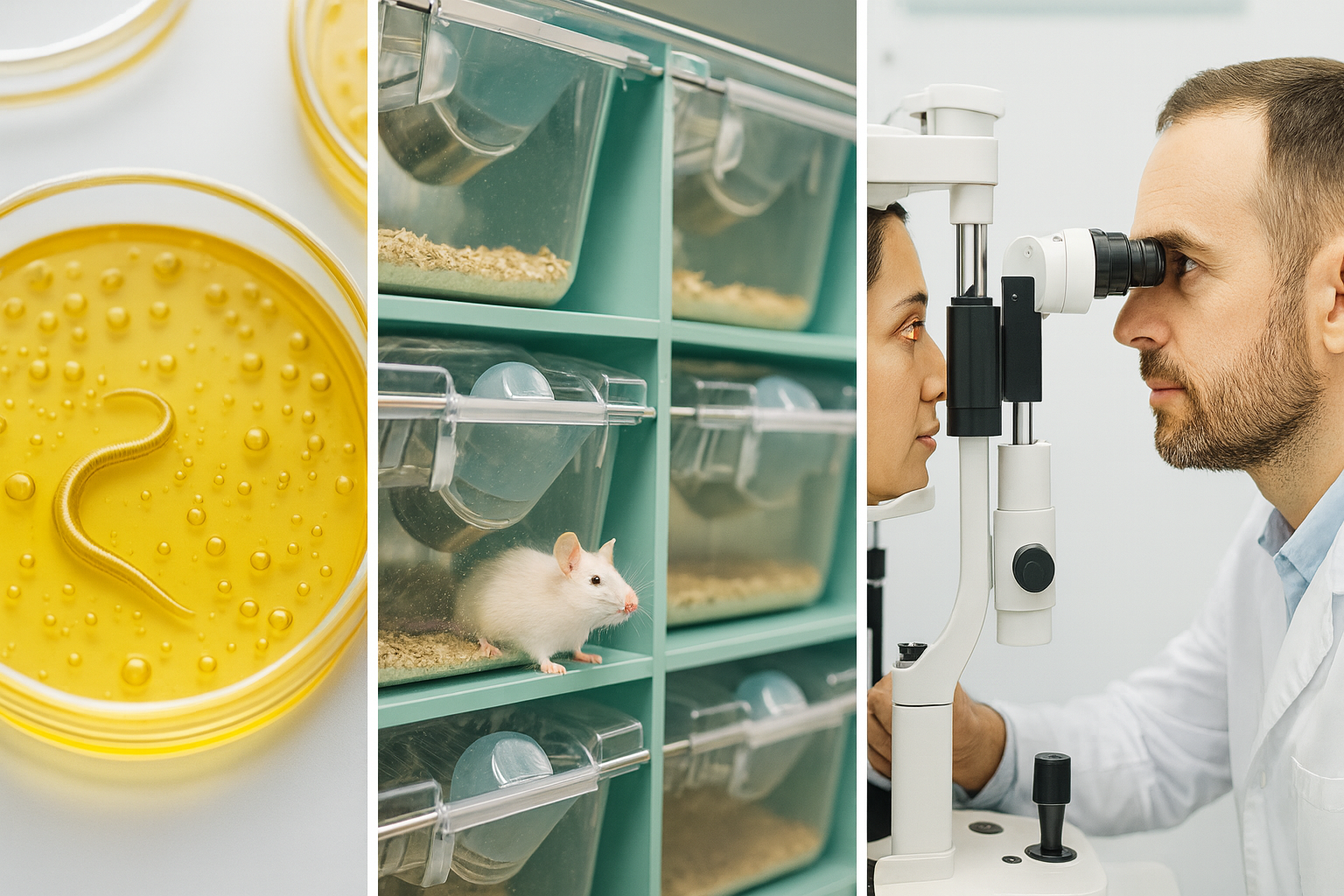
The three literatures behind the GLOW stack, and the three settings they were run in.
Three evidence bases do not add up to one
Here is where stacking logic fails on its own terms.
Peptides in combination are not simply the arithmetic sum of their parts. The chemistry literature on multicomponent peptide assemblies describes exactly this: combining peptides produces behaviour the individual components do not show.[11] That review is about self-assembly rather than pharmacology, and the direction of the surprise is unpredictable in both fields. Novel behaviour is not a synonym for better behaviour.
Drug development treats this as settled. Combination products are evaluated as their own entity, with their own requirements, rather than inheriting the evidence of their components.[12] A regulator will not accept “each part was studied separately” as a submission, and neither should a reader.
What is missing: no published human trial has given GHK-Cu, BPC-157 and TB-500 to the same person. There is no combined safety data, no combined dosing data, and no combined outcome data, because the study has not been run.
Apply the three findings above honestly and the stack collapses into its parts. A cream trial in resurfaced facial skin. Rat tendon and muscle models. An eye drop in corneal disease. Three different species, three different routes, three different target tissues, presented as one protocol for one purpose.
What would make the GLOW protocol worth taking seriously
A short list, and none of it is exotic:
- A human injectable trial of GHK-Cu, at any dose, with any tissue endpoint outside the skin.
- A controlled human trial of BPC-157, which its own systematic reviewers have been asking for.
- Any human data on the TB-500 fragment, as distinct from the full thymosin beta-4 peptide that carried the corneal trial.
- One study of the three together, which is the only design that could test the actual claim being made.
Item four does not exist, and at present nobody is running it, which leaves everything sold as a GLOW protocol resting on an inference stacked across three unrelated literatures that nobody has checked.
Bottom line: the GLOW stack has no evidence of its own. Its components have evidence, in nematodes, in rats, and on the surface of the human eye, and none of that transfers to three peptides injected together for skin and tendon repair.
A protocol that has never been studied is untested, whatever the label on the vial says. Why would anyone pay a premium for the combination when the combination is the one part nobody has looked at?
This article is for research and informational purposes only and is not intended to diagnose, treat, cure, or prevent any disease. The peptides discussed here are sold for research use only and are not for human consumption. Nothing in this article constitutes medical advice. Consult a qualified clinician before making changes to a health, training, or supplementation protocol.
References
- The GHK-Cu delays aging in Caenorhabditis elegans via coordinated regulation of mitochondrial function and activation of DAF-16/SKN-1 pathways.. Biogerontology, 2026.
- Biological activities of thymosin beta4 defined by active sites in short peptide sequences.. FASEB journal : official publication of the Federation of American Societies for Experimental Biology, 2010.
- Effects of topical copper tripeptide complex on CO2 laser-resurfaced skin.. Archives of facial plastic surgery, 2006.
- Peptides: Emerging Candidates for the Prevention and Treatment of Skin Senescence: A Review.. Biomolecules, 2025.
- Emerging Use of BPC-157 in Orthopaedic Sports Medicine: A Systematic Review.. HSS journal : the musculoskeletal journal of Hospital for Special Surgery, 2025.
- Impact of pentadecapeptide BPC 157 on muscle healing impaired by systemic corticosteroid application.. Medical science monitor : international medical journal of experimental and clinical research, 2010.
- BPC 157 and blood vessels.. Current pharmaceutical design, 2014.
- 0.1% RGN-259 (Thymosin ß4) Ophthalmic Solution Promotes Healing and Improves Comfort in Neurotrophic Keratopathy Patients in a Randomized, Placebo-Controlled, Double-Masked Phase III Clinical Trial.. International journal of molecular sciences, 2022.
- Structure, function, and evolution of the beta-thymosin/WH2 (WASP-Homology2) actin-binding module.. Annals of the New York Academy of Sciences, 2007.
- Animal studies with thymosin beta, a multifunctional tissue repair and regeneration peptide.. Annals of the New York Academy of Sciences, 2010.
- Multicomponent peptide assemblies.. Chemical Society reviews, 2018.
- Development of Drug-Device Combination Products and Generic Substitution in the United States.. Innovations in pharmacy, 2025.